The Corporatization of Conspiracy Theorists
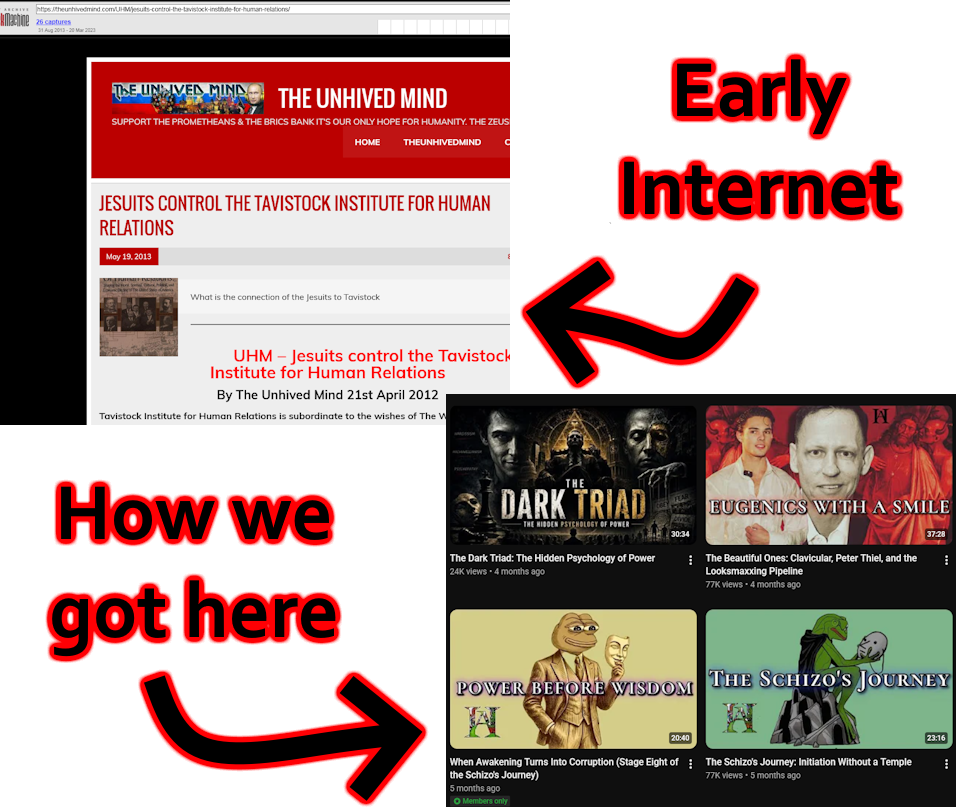
A certain annoyance I've had with some people that I hoped would join me in my intents to learn about what we call "conspiracy theories", is that these days there's a lot more arrogance and layering in this kind of community than I would've hoped. It used to be normal back in the early days of YouTube, 15 years ago, for people to be more lenient when researching certain topics, always welcoming people to disprove any of their research of it were to contribute to finding the truth.
But I realized that the truth is, a lot of people simply don't have any real intention to learn about these things. They just want to feel like they're "right" about who controls everything, and often even approach it in a narcissistic kind of way. If you've tried to tell a friend about some reading you've been doing about some sort of suspicious group, you might come across a response like:
"Maybe that's true, but don't make a big deal out of it. I just think there's a bunch of crazy shit going on!"
This seemingly humble response is a cope to avoid responsibility. And I guarantee you anyone who talks that way, as if they're above it all, is going around stating their personal opinions and politics on their own time.
I think the problem in particular stems not only from a lack of wanting to do genuine research, such as only looking up certain kinds of 20 minute YouTube videos, and never reading books. But not only that, but it's the desire to only try to have an opinion of who's on top of it all. And it's this mentality that leads to distraction and overall a bad influence, where people just end up doing nothing about any problems in their lives. Here's another midwit response you might get:
"I believe everything leads back to aliens, reptilians and the supernatural in the end. There is no point in worrying about the politics of what goes on in this realm."
I think a lot of us believe in things like aliens and higher beings; I do... But I still very much oppose this excuse. A very convenient cope to go around either blackpilling, or to go around acting like some guru, assuming anyone who opposes your views is ignorant.
It's that perspective that leads to true dis-empowerment and a bad influence on others. It leads us to think we just have to "play by their rules" in whatever conventional way possible. Well I can tell you as someone who actually has put the effort in to learn who "they" are in what areas of my life, I believe there are ways to lawfully play by less of their rules, and at least experience this modern life with less stress than the average person.
I don't just go around avoiding research about my legal status, and what the meaning of a U.S. Citizen really is. I looked into it, and as a result I can lawfully not pay income tax. And I have also learned how to lawfully stop paying taxes on property by means of setting up a Religious Trust (there's a couple other small steps, like clarifying it with your County Assesor). It's just from patiently being open to learning. The UNITES STATES CORPORATION is indeed run by people in secret societies, but at the end of the day it's just politics and a bit of jurisdiction.
The extent of what most of these gurus will tell you is about how George Washington and his friends were Freemasons, and that America is one big masonic prison. In reality, America has always had two sides to it. Freemasonry was created by the Jesuits in order to make those who opposed to Catholic Church believe they were fighting against them, without realizing that the Freemason's Unknown Superior showed indication of being the Black Pope, Superior General of the Jesuits.
America gave freedoms that still exist today, but the process was overseen by their enemies. The freedoms that anyone can obtain are simply gate-kept by certain groups; their only real power over people is knowledge. The real meaning behind the 1st Amendment, for example, is not freedom of speech. It is freedom from taxation of any kind.
"Congress shall make no law respecting an establishment of religion, or prohibiting the free exercise thereof; or abridging the freedom of speech, or of the press;"
In other words, a religious organization (which Congress has no right to judge the validity of), is free to have its property private from any other organization. And they can't make a law favoring the establishment of any certain religion against another.
But the point of what I try to learn about isn't just about deciding whether Jesuits run the world. It's about the lack of satisfaction I feel without knowing how to make sense of the society we are a part of. When you de-plug a little from the wave of these social media-based gurus, you might be able to look at history more responsibly, not just trying to discount most events as if they aren't important.
I wrote before about how I opposed the criticism Professor Jiang was receiving. Sure, he was big on YouTube, but he was also one of the only people in this space who spent the hours actually looking into various parts of history.
It's interesting how quickly many other conspiracy theorist channels felt the need to try and defame this person, as if he was a threat to them. Like I said earlier, I think the problem with these people is that not only do they want to throw the baby out with the bathwater (instead of simply taking what is true to them and listening), but they judge everybody by the overall thesis instead of admitting that nobody is right about everything.
Jiang made numerous near-future predictions that I don't really believe in. But does that make him a bad person? Isn't that the same thing everyone with opinions of their own does? Disavowing countless hours of research is not a fair response to someone just because they may be wrong about their opinions on Israel. As if we don't all have inaccurate theories of the future. Even if it turned out that he was some controlled agent, that shouldn't even be the primary concern.
You don't tend to see this kind of sensitive reaction from those who don't believe in conspiracy theories. You actually see it the most from the other theorists. And this, to me, is proof of a true phony. Someone who only cares about being right all the time, and cares more about having something witty to say as opposed to wanting to learn together with a community, and help elevate human freedom.

I felt like the same thing happened five years ago with the QAnon movement. I don't believe QAnon was a real thing, but why were people so sensitive about it? Again, it wasn't just leftists that made exaggerate claims about them. It was also the conspiracy theorists; it was as if QAnon offended their pride as true theories or something. But I don't see how being a QAnon supporter makes you any different than any other misguided theorist. I've explained why I think people are often distracted by Zionism and Freemasonry, but I don't go around saying they're crazy. I think Biden won the 2020 election, but at the same time I think there was a lot of intentionally directed anger in the way they presented that news. And on top of that, exaggerated stories of how violent that protesters on January 6th were.
Perhaps the real psyop behind QAnon was to get people to just want to abandon conspiracy theories all together so they could just label it as "QAnon." Again, throwing the baby out with the bathwater.
This is what leads me to the main point I'm trying to make. What people really don't want us to be researching is all those little groups in between. We're always so concerned on what rules everything in the shadows, yet we can't properly come to that conclusion without first looking at the pieces that make it up. And I believe it's our responsibility at people who are being affected by such organizations, to take the time to learn what these groups are. Because I've already noticed how much intentional censorship there seems to be when you mention certain organizations in this category.
How many of your self proclaimed conspiracy gurus out there explain what the Club of Rome is, and how they originated the concept of environmentalism and fears about Climate Change? Have you heard of the Tavistock Institute? They came right from the City of London, and basically invented The Beatles and almost all rock n' roll. Systematically dis-empowering the boomers and getting them to become drug addicts that no longer believed in committing to their partners. Or how about the late East India Company, who originated the American Flag and controlled almost all resources, seemingly linked to the Papacy?
"The East India Company was a major subsidizer of the Jesuit mission to Beijing. The Jesuits, in turn, interceded with oriental monarchs to secure lucrative commercial favors for the company, including monopolies on tea, spices, saltpeter (for explosives), silks, and the world's opium trade. Indeed, according to Reid's Commerce and Conquest: The Story of the Honourable East India Company, the Company appears to owe its very existence to the Society of Jesus." ~ F. Tupper Saussy, Rulers of Evil
And the interesting thing is, if you look on old blogs from 20-year old sites, you see a lot more open talk about these groups. In other words, before the World Wide Web became more easily censored and corporatized. It's almost like they were onto something, but then over time, certain other figures decided to poison those outlets with slow distractions. Some of the only big names I know of that seem to still stay on this stuff would be people like Walter Veith, Zackary K. Hubbard (of Gematria Effect News) and Santos Bonacci. Zackary Hubbard was banned banned on Twitter sometime a year ago after I saw him posting so much about Jesuits. Walter Veith pretty much doesn't use it at all (apart from the account for the ministry he works for), and Santos Bonacci's Twitter hardly has any traction compared to his YouTube Channel, even though he appears to us it actively.
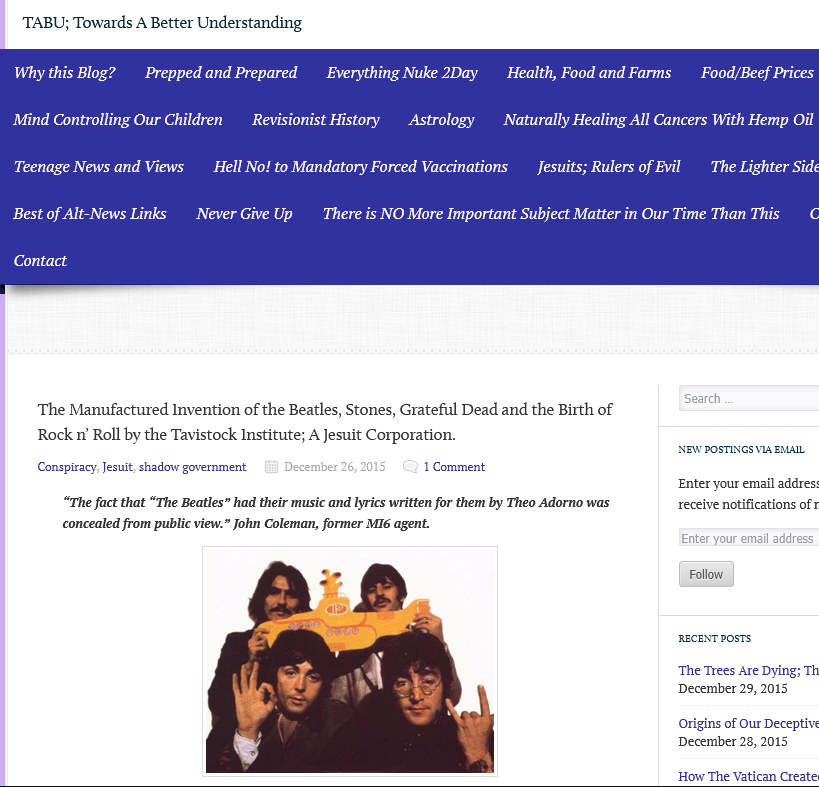
Yet another excellent blog that you can only access through the Wayback Machine.
It seems to me that the 90s were a time when information was just starting to get passed around more freely, and the internet took some time to figure out how to create distractions to regulate it in such a free system. I don't think censorship is directly the goal of these organizations most of the time. It's distraction. This information has always been out there; people just choose not to look.
My favorite history book I've read is F. Tupper Saussy's Rulers of Evil. I think it's one of the only times someone took a real objective look on history, particularly American History, and make sense of it as well as trying to make sense of other secret societies. And I like his point of view on the mentality these people seem to have.
But I think there's one slightly similar book, which I haven't taken the time to read fully, that has been ignored yet out in the open in a similar way. That would be Dr. John Coleman's document on The Committee of 300. Without trying to fall into the trap of just thinking about "who rules us all" as I discussed before, I can recognize regardless that his research seems to really correlate with a lot of what Tupper Saussy wrote about, and how some of these early websites seemed to be piecing the two together.
They both talked about the East India Company, and John Coleman was the one who really delved into a lot of those non-profit organizations that I mentioned before, who's influence goes unnoticed due to their intentional boring sounding public images. And some people seemed to be making connections between the Tavistock Institute and the Jesuits, such as in this now-censored blog post.
Whether he was right about everything he said or not, Coleman had the right idea of really getting on their case for every footprint they've left. After all, a lot of these organizations are just as much alive today.
However there is one element I've noticed to his writing that I don't see eye to eye with, and it's the sort of emotional terror he tends to express. For example, there's a line where he says:
"Private gun ownership will have become a thing of the past in the United States by the year 2010."
As we can see today, that is not true. If anything, maybe most people don't educate themselves on how to make their gun ownership entirely private, but it's still an option regardless. Or to say the least, may depend on there you live. But it's been common for so many people throughout every generation to have exaggerated fears on how many of our freedoms will be taken away.
Tupper Saussy explained how they don't want to take away all out freedoms, even though it often seems like they do. But the truth is, they really only want to go after the people that give them a hard time. If you live a good life, you can likely be free to do so. Most people have plenty of problems, and the truth is they might be just as evil as the ones in power that they complain about. And that is what I believe.
For example, anyone would have a problem with Epstein and what he did, but did you also know that a lot of boomers his same age range had a similar history of getting away with dating underage girls? But it's easier to look at someone to blame. How are we to know many of the other poor folk wouldn't end up being just as corrupt if they had power?
But Coleman seemed to still fall for the psyop of Jesuits and Freemasons being the same group, instead of conspiring that the Freemasons are under the Jesuit's control. So by that logic, I think he still may have, like anyone has, missed a point or two.
But I think it's more important that he researched the Black Nobility; which is believed to be the series of families that turned into the Papacy. So as far as I'm concerned, he could unknowingly be describing the Jesuits.
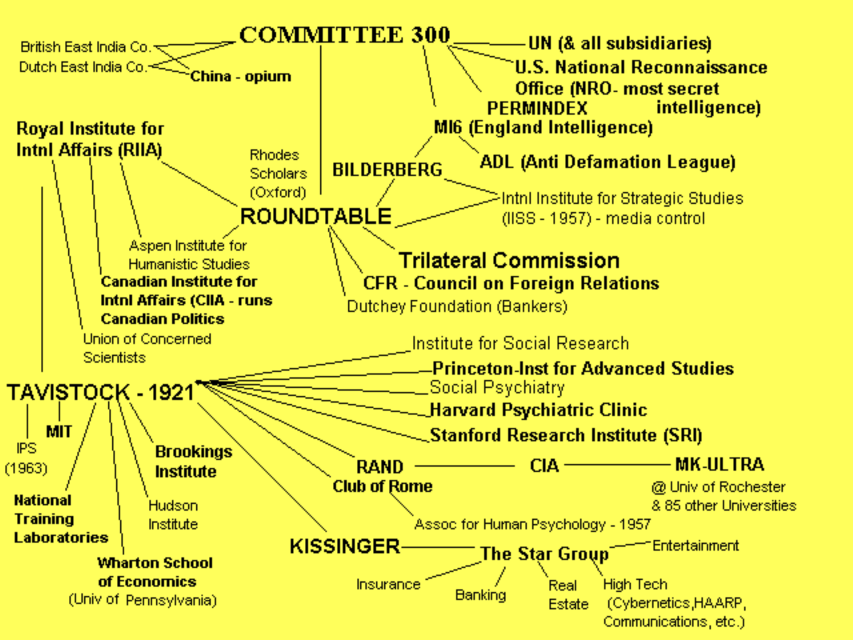
This was the diagram of the power system he believed in.
So while I stand against those who want to act like they see above it all, I will say I haven't seen any evidence the claim that the Jesuits are basically on the top, and have demonstrated an impressive record of distracting people every few years.